
Retainers After Braces in Northbrook, IL
A retainer holds your teeth in their new positions after braces or aligners come off. Wear is full time at first, then nightly for the long term.
Teeth drift throughout life, so retention is not a short phase at the end of treatment. It is the part that protects everything the treatment achieved. One set of retainers is included in your treatment fee at Janzen & Chwa Orthodontics.
Getting the braces off is the day everyone remembers, but the retainer is the part that decides whether the result is still there in ten years.
Why Do Teeth Shift After Braces?
Teeth are not set in concrete. They sit in bone, anchored by elastic fibers that stretch during treatment and then try to pull the tooth back toward its original position.
When active treatment ends, the bone and soft tissue around each root are still adapting to the corrected alignment, and that adaptation takes months rather than weeks. Throughout that period the teeth genuinely want to relapse, and a retainer is what holds them steady while the surrounding tissue stabilizes.
Drift continues afterwards too, because chewing forces, muscle pressure and ordinary aging all move teeth slowly for the rest of your life, including in people who never had orthodontic treatment at all. That is why long-term nightly retainer wear is standard clinical advice rather than an upsell.
What Types of Retainers Do You Offer?
Removable Retainers

Clear Retainers
Clear retainers are nearly invisible and fit closely over the teeth, making them the more discreet option.
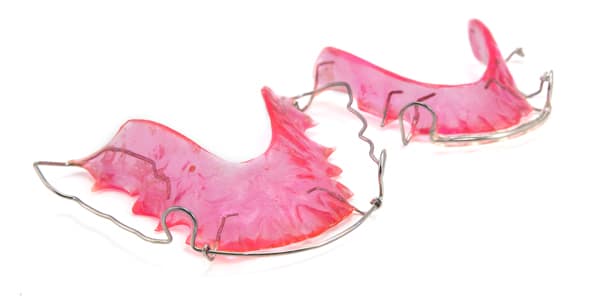
Hawley Removable Retainers
Fixed Retainers
A thin wire is bonded behind the front teeth, permanently out of sight and working continuously, so there is nothing to remember and nothing to lose.
The trade-off is hygiene, because flossing around a bonded wire requires a threader, and your dentist needs to check the bond at every
Which one suits you depends on how your case finished. Patients who began with significant crowding or rotation, and anyone we judge likely to relapse, often do best with a fixed retainer behind the lower front teeth combined with a removable retainer on top.

How Long Will You Wear a Retainer?
The first year. Full time, out only for eating and brushing, because this is the period when relapse happens fastest and the retainer matters most.
After the first year. Nightly, indefinitely for most patients, which becomes as automatic as brushing once it settles into the routine.
Long term. Once wisdom teeth have been dealt with and the alignment has proved stable, some patients move to a few nights a week, and we will tell you when that is reasonable based on your own teeth rather than on a calendar.
We check retention at routine visits every six to nine months, with X-rays roughly every eighteen months while the wisdom teeth are still developing.
Who Needs Extra Retention?
Some patients drift more than others. Extra vigilance is worth it if you:
- Breathe through your mouth
- Clench or grind your teeth
- Have a tongue thrust or unusual tongue posture
- Play a reed instrument
- Bite your lip or chew on objects
- Started treatment with large gaps or badly rotated teeth
If any of these apply, say so at your final visit. We will plan retention accordingly rather than hand you the standard schedule.
How to Look After a Retainer
Keep it away from heat. No dishwashers, no hot water and no car dashboards, because the plastic distorts above roughly 115 degrees and a warped retainer will no longer seat properly.
Use the case, every time. Retainers wrapped in a napkin end up in the bin, which is comfortably the most common way one is lost.
Keep it away from the dog. Dogs are unaccountably fond of retainers, and we replace several every year for exactly this reason.
Clean it daily. Mild soap and a soft brush, before and after wear, since toothpaste is abrasive enough to cloud the plastic over time.
Tell us early if something changes. A retainer that feels loose, has cracked, or no longer seats properly is not holding anything, so call us rather than persevering with it.
If Your Retainer Is Lost or Broken
Call us and we will make a new one. There is a replacement fee, which is worth budgeting for over the long run, particularly with teenagers.
Do not wait, though, because teeth move within weeks and a retainer manufactured after months of drift may no longer fit. If that has already happened, come in and we will tell you honestly whether a new retainer will hold what remains or whether a short course of treatment is needed first. Our guide to what treatment costs explains how that is quoted.
Frequently Asked Questions About Retainers
I stopped wearing my retainer months ago. Is it too late?
Come in and let us look. Sometimes the old retainer still seats with pressure and can be worn back in. Sometimes the teeth have moved too far and a short treatment is needed first. Either way, the answer takes one appointment to get.
Should I choose a fixed or a removable retainer?
If you’re likely to forget, fixed. If you would rather not deal with flossing around a wire, removable. Many patients end up with one of each, and we’ll recommend based on how your case finished rather than on preference alone.
My retainer feels tight when I put it in at night. Is that a problem?
A little tightness after a night or two off is normal and means it is doing its job. Tightness that does not ease within a few minutes, or a retainer you have to force, means the teeth have moved. Call us rather than pushing harder.
Can I wear my retainer only a few nights a week?
Eventually, some patients can. Not in the first year, and not without us telling you the timing is right. Cutting back early is the most common reason a good result quietly comes undone.
Questions About Your Retainer?
Call or text (847) 272-0600, or request an appointment online. We are at 1220 Meadow Rd, Ste 300 in Northbrook, and we make retainers for patients whose original treatment was done elsewhere as well as for our own.